SERVICE CLOUD & CUSTOMER SERVICE
Customer service without the runaround.
We shape Service Cloud around the way requests actually move — so agents have the context they need, ownership is clear and customers do not have to repeat themselves.
Typical starting point: Requests arrive through different channels, information is spread across systems and too many cases still depend on manual routing or individual knowledge.
 AI-generated
WHERE SERVICE SLOWS DOWN
Where service work starts to drag.
Service friction usually comes from missing context, unclear ownership and too much manual work between teams — not from one missing feature.
Context is missing
- Agents open a case without the customer, product or contract information they need.
- The same facts are searched for repeatedly across multiple systems.
Requests land with the wrong team
- Routing depends on broad categories or manual forwarding.
- Cases move between teams before real ownership is established.
Too much work stays manual
- Agents repeat searches, status checks and handoffs that could be supported by the platform.
- Knowledge lives in personal notes, inboxes or workarounds instead of the service process.
 AI-generated
START WITH THE SERVICE MODEL
Define how service should work before configuring the platform.
Before building queues, automation or screens, agree on how requests should be handled and what each team needs to resolve them.
Which request types matter most
What information should arrive with each request
Who owns the request at each stage
When routing should be automatic and when it should not
What knowledge agents need to resolve common cases
How handoffs and escalations should preserve context
FROM REQUEST TO RESOLUTION
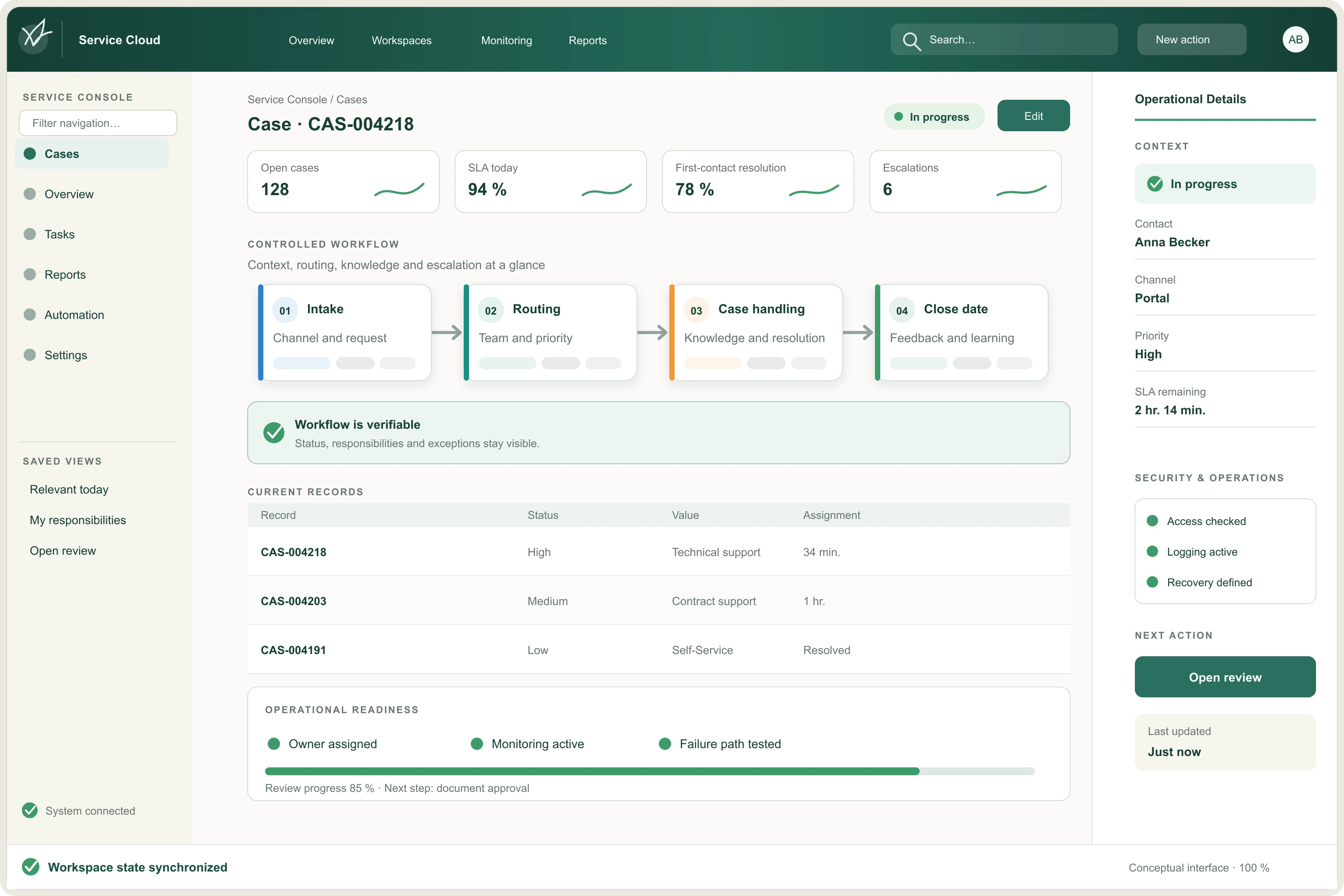
How a customer request should move through service.
A good service flow makes the next step obvious — for the customer, the agent and the team taking over.
ChannelWhere does the request arrive?
ClassificationWhat is the request really about?
RoutingWhich team should own it next?
HandlingWhat context, knowledge or action is needed?
ResolutionWhat closes the request — and what should the customer know?
FeedbackWhat should be learned from the case for next time?
 AI-generated
WHAT GOOD LOOKS LIKE
What a service process looks like when it is under control.
The goal is not more automation. It is less searching, fewer avoidable handoffs and a process agents can explain and operate consistently.
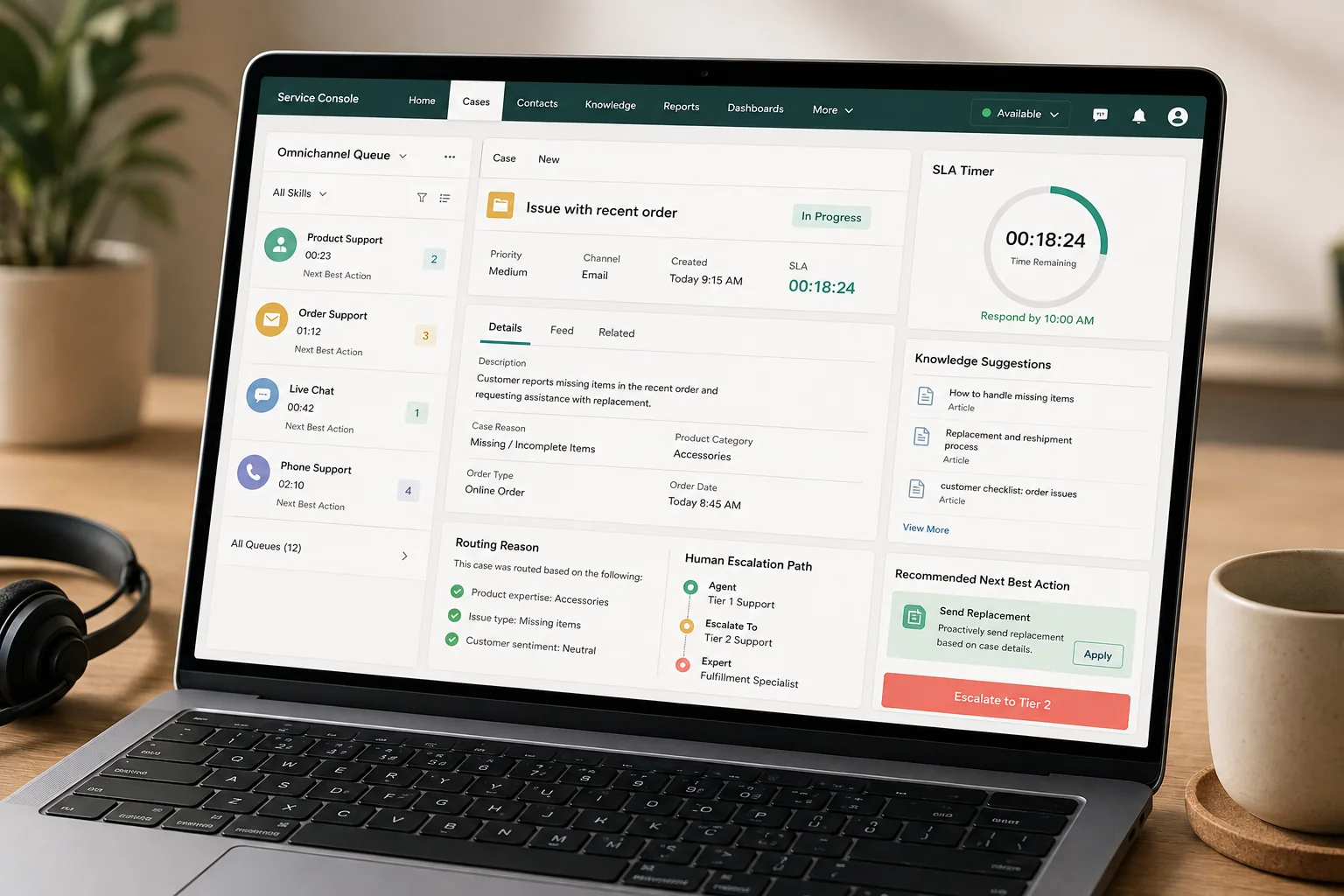
Agents see the relevant customer and case context without searching across systems.
Requests reach the right team with clear ownership.
Common questions are supported by current, usable knowledge.
Handoffs keep the original request, previous actions and open questions intact.
Service teams can see where cases stall, repeat or bounce between teams.
BEFORE YOU BUILD
Questions worth answering before configuration starts.
Service complexity grows quickly when routing, ownership and automation are added before the operating rules are agreed.

Fit
Does the flow match the real service work?
- Are request types and queues based on how teams actually work?
- Are we solving a real service problem or only recreating the old process in Salesforce?
Control
Can ownership and exceptions be managed deliberately?
- Who can reroute, escalate or override a case — and under what conditions?
- Which actions should stay with agents and which can be automated safely?
Lifecycle
How will the service model change over time?
- How are new request types, teams and channels introduced?
- How are routing rules, knowledge and automation reviewed and improved?
 AI-generated
USEFUL DELIVERABLES
Outputs service and IT can keep using.
The work should leave behind a shared service model — not knowledge that only exists in workshops or configuration.
Request and case model with ownership and routing rules
Context and data requirements for key service scenarios
Knowledge, escalation and handoff principles
Prioritized roadmap, open decisions and operating standards
HOW WE GET THERE
From customer request to a service model teams can run.
Start with the real request, design the service flow around it and stabilize the operating model before adding more complexity.
Assess
Review real request types, handoffs, delays and workarounds.
Design
Define ownership, routing, context and knowledge for the target flow.
Test
Validate common cases, exceptions, permissions and handoffs with real scenarios.
Stabilize
Put monitoring, support and improvement ownership in place for day-to-day operations.
 AI-generated
Where does your service process break down?
If requests bounce between teams, agents keep searching for context or customers have to repeat themselves, we can help turn the service flow into something easier to run.