DATA 360 & CUSTOMER DATA
Customer data that serves a real use case.
We help you bring together the customer data a real CRM, marketing, service or AI use case needs — with identity rules, quality checks and activation built around that purpose.
Typical starting point: Data is spread across several systems, profiles do not line up cleanly and the team is unsure which information actually matters for the use case.
 AI-generated
WHERE DATA PROJECTS STALL
Where Data 360 projects start to lose focus.
Most Data 360 problems start before the platform does: too much data, unclear identity rules or no shared view of what the activation actually needs.
Too much data, no clear goal
- Sources are connected because they exist, not because the use case needs them.
- The model grows faster than the business value.
Identity rules are unresolved
- Teams cannot agree which identifiers are trustworthy enough to match profiles.
- More records are merged than the use case can safely support.
Activation comes too late
- Segments or audiences are designed only after the data model is already fixed.
- The team discovers too late that the intended destination needs different data, timing or consent logic.
 AI-generated
START WITH THE USE CASE
Define the activation before the data model.
Before ingesting more data, agree on the customer decision or action Data 360 is supposed to support.
Which business use case Data 360 should improve
Which source data that use case truly needs
Which identifiers are strong enough for matching
Which data-quality rules matter for the intended outcome
Where the profile or audience will be activated
Who owns the data, identity rules and later changes
FROM SOURCE TO ACTIVATION
How customer data becomes something the business can use.
A useful Data 360 flow connects only the data needed to identify the customer, support the decision and activate the result.
SourceWhich system provides the data?
Data contractWhich fields, meaning and quality can the use case rely on?
IdentityWhich records should represent the same customer?
ProfileWhich attributes and history are relevant to this use case?
ActivationWhere will the result be used — CRM, marketing, service or AI?
 AI-generated
WHAT GOOD LOOKS LIKE
What a strong first Data 360 use case looks like.
The best starting point is small enough to prove value and specific enough to show whether the data and identity model are working.
One clearly defined business use case
A limited set of source systems and attributes
Identity rules that can be explained and tested
A known activation destination and expected outcome
A feedback loop that shows whether the activation actually worked
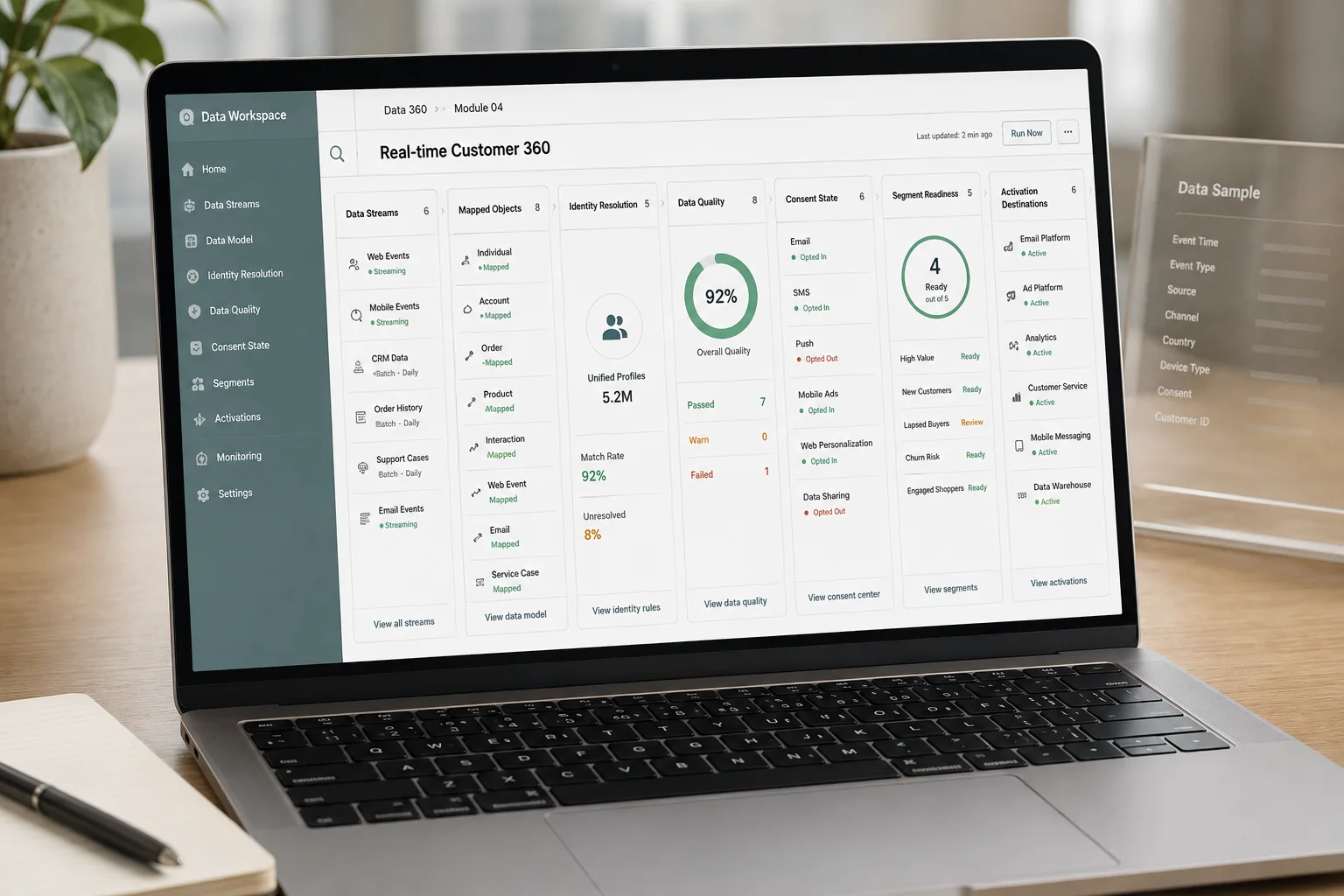
BEFORE YOU BUILD
Questions worth answering before the first data load.
Data complexity grows quickly when teams ingest first and decide on purpose, identity and ownership later.

Fit
Does this data belong in the use case?
- Will the data change the decision, audience or action?
- Is the source reliable enough for the role it is expected to play?
Control
Can the data and identity rules be governed deliberately?
- Who owns the source, the mapping and the matching logic?
- How are bad data, false matches and exclusions handled?
Lifecycle
How will the use case change over time?
- What happens when sources, identifiers or activation destinations change?
- How are data quality and identity rules reviewed as the use case evolves?
 AI-generated
USEFUL DELIVERABLES
Outputs your team can keep using.
The work should leave behind a shared data and activation model — not knowledge that only exists in one implementation team.
Prioritized Data 360 use case with success criteria
Source, mapping and data-quality requirements
Identity rules with test cases and exclusions
Activation design with destination and feedback loop
Ownership, monitoring and change guidance
HOW WE GET THERE
From use case to customer data the business can act on.
Start with the decision or audience, model only the data it needs and test the activation before expanding the scope.
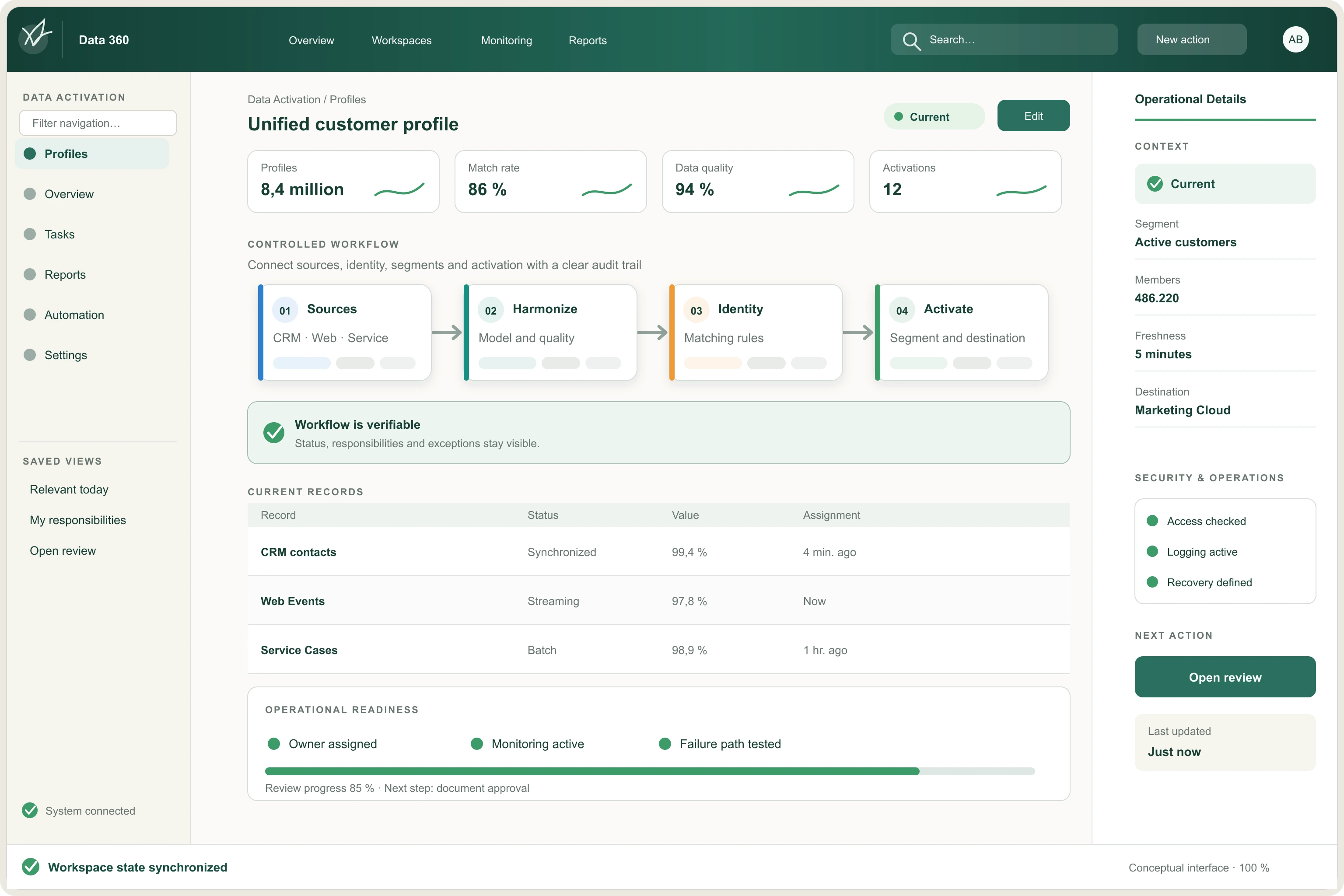
Focus
Choose one use case and define the business outcome it should improve.
Model
Define sources, mappings, identity rules and required attributes.
Activate
Send the result to the CRM, marketing, service or AI process that needs it.
Review
Measure data quality, match quality and business impact before extending the model.

Which use case should Data 360 support first?
If you know the customer outcome you want but the data, identity rules or activation path are still unclear, we can help turn that into a focused first Data 360 scope.