
SET THE OUTCOME FIRST
The pilot needs a result you can verify.
A pilot should prove that one piece of work becomes meaningfully better — not simply that an AI model can produce a plausible answer.
Agree before the pilot starts how you will judge the result: time saved, quality improved, less rework, better completeness or another outcome that matters to the team.
TASK BEFORE TECHNOLOGY
Clarify the task first.
Describe the work before discussing Agentforce, prompts or models. What comes in? What should come out? Which judgment is required? Which action, if any, should happen next?
Then choose the technology.
Once the task is concrete, it becomes much easier to see whether classic automation, AI assistance or an agent is the right fit.
EXAMPLE USE CASE
Example: Prepare service requests before an agent takes over.
Service work is a useful AI candidate when the system has to interpret unstructured information, bring relevant context together and prepare the next step without making the final decision itself.
The value is not that AI “answers”. The value is that the human starts with better-prepared work.
- Understand the request
Summarize the customer’s issue from the message, case history and relevant context.
- Find the relevant information
Use approved knowledge and customer information that the current role is allowed to access.
- Prepare the next step
Draft a response, classify the request or suggest what the agent should review next.
- Stop at the boundary
Hand over when the request needs a business decision, an exception or an action the AI is not authorized to perform.
Which type of support fits the task?
The simplest suitable approach is usually the best one.
Agentforce Pilot: From Prototype to Production Decision shows how to test a selected use case under real conditions.
Do not choose the most advanced option. Choose the least complex option that solves the work well.
QUALIFY THE USE CASE
Qualify one specific use case first.
The first pilot should be small enough to understand and important enough that a real improvement would matter.
- The task happens often enough to justify improvement.
- The required data and knowledge are available.
- A good result can be described and reviewed.
- The point where AI must stop can be defined.
Further steps (1)
- The expected benefit can be measured or assessed consistently.
- Repeatable task
- Available data
- Reviewable result
- Clear stop boundary
- Measurable benefit
BEFORE THE PROTOTYPE
Four questions before the first AI prototype
What specific piece of work should improve?
Avoid broad goals such as “AI in service”. Name the actual task.
Which information does the AI really need?
Limit the context to the data and knowledge required for that task.
What may the AI prepare, decide or execute?
Separate drafting, business judgment and system action.
How will we know the new approach is better?
Agree on the quality, time, rework or user outcome that will be compared.
START SMALL
Move from idea to pilot in three steps.
The most useful starting point is small, verifiable and deliberately bounded.
01
Narrow down the task
Choose one repeatable piece of work and define the result the pilot should improve.
02
Secure the boundaries
Define the data, permissions, allowed actions and point of human handoff.
03
Check the impact
Test against real cases and compare the outcome with the way the work is done today.
WHAT GOOD LOOKS LIKE
Signs of a useful AI application
VALUE
A specific improvement is measurable
The team can tell whether the task became faster, more complete or easier to handle.
BOUNDARIES
Permitted actions are limited
The AI has only the access and authority the task genuinely needs.
DATA
The data questions remain answerable
Sources, permissions and responsibility for the information remain visible.
If benefit, boundaries or data responsibility are vague, the use case is not ready for production.
Not every task needs AI. Every AI application needs a clearly bounded task.
Common questions about getting started
Does every new automation need an agent?
No. If the rules are explicit and the result should be deterministic, traditional automation is usually easier to test, operate and explain.
Should we start with a chatbot?
Only if a conversational interface is genuinely part of the use case. Internal assistance, summaries or prepared responses are often better first steps.
How large should the first pilot be?
Small enough that task, data and boundaries stay understandable — but large enough to test the outcome on real work.
Sources and further information
Primary documentation and reference material for Salesforce AI, Agentforce and controlled AI use cases.
- Salesforce — How Agentforce worksChecked on
Supports the assessment of Agentforce, trusted AI and traditional versus agentic automation; recheck product details before publication.
- Salesforce Architects — Determining agentic versus traditional workflow automationChecked on
Supports the assessment of Agentforce, trusted AI and traditional versus agentic automation; recheck product details before publication.
- Salesforce — How We Build Trusted AIChecked on
Supports the assessment of Agentforce, trusted AI and traditional versus agentic automation; recheck product details before publication.
Topics in this article
THREE WORKING VIEWS
Three views that keep AI assistance controllable.
Three illustrative configured workspaces show scope, handoff and decision history. All records and test results are fictional.


Topic scope and permitted actions
Illustrative configured UI · Fictional data.
Swipe with your finger or drag with the mouse button held down. You can also select an image or use the arrow keys.
Image 1 of 3: Topic scope and permitted actions
Continue reading

The Data Foundation for AI: What Agentforce and Data 360 Actually Need
AI and Data 360 do not need every field to be perfect. They do need the important data to mean what teams think it means — with enough ownership, evidence and context to use it safely. The practical goal is not “clean all the data.” It is to make the critical data trustworthy enough for the process you want to improve.
Read article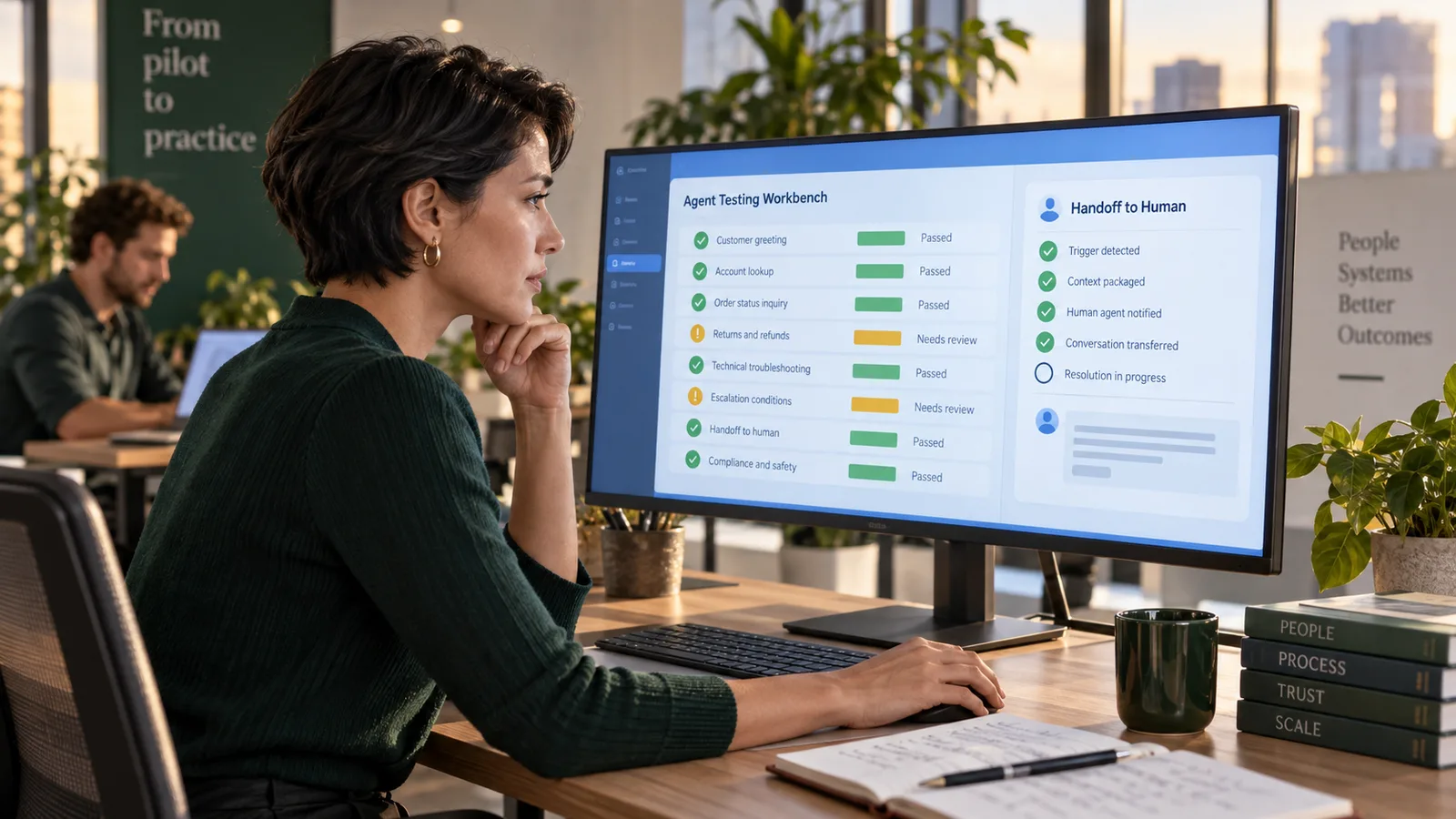
Agentforce Pilot: From Prototype to Production Decision
A working Agentforce prototype is not yet a production case. The pilot should answer a harder question: does the use case create enough value, with acceptable behavior, permissions and operating effort, to justify running it day to day? That means defining the go/no-go criteria before the pilot starts — not after the demo looks promising.
Read article
Escaping the Monolith: Designing Scalable Multi-Agent Ecosystems in Agentforce
A practical guide to replacing one overloaded Agentforce agent with a lean router, bounded specialists, explicit handoffs, and evidence that the architecture scales.
Read article